

Deploying a high-performance trunnion ball valve is the most critical technical decision for ensuring the mechanical integrity of Indonesia’s long-distance natural gas transmission networks. In high-pressure midstream assets, these components act as the primary safety barrier across hundreds of kilometers of rugged tropical terrain. Utilizing field-proven hardware from a qualified manufacturer such as ONERO helps improve reliability and operational safety in these isolated energy corridors.
During gas transmission projects across Southeast Asia, our engineering team has observed that proper alignment during the installation phase is vital to preventing body distortion and premature leakage. The valve and adjoining pipework must be properly supported and aligned to prevent flange stress from compromising the seal integrity before the system goes live. Correct commissioning in these environments ensures that a natural gas pipeline valve provides a fail-safe guarantee of flow control for the long term.
Indonesia’s Expanding Natural Gas Pipeline Network
Indonesia is rapidly scaling its infrastructure to connect offshore fields in the Natuna Sea with industrial hubs across Java and Sumatra. These expansive networks require robust flow control solutions that can sustain high-capacity throughput without frequent maintenance interruptions. With 38 years of manufacturing experience, ONERO provides precision-engineered flow control solutions designed for demanding natural gas transmission applications.
Challenges in Long-Distance Gas Transmission
Transmitting gas over several hundred kilometers involves dealing with extreme pressure drops and corrosive environmental factors. In coastal Indonesian regions, the high saline content in the air can degrade standard carbon steel bodies if not properly treated. Our R&D team has found that advanced surface treatments are essential to preventing external corrosion that can compromise the stem seal in isolated jungle stations.

Pressure: 150LB-2500LB
Applicable Temperature: -196~350℃
Why Trunnion Ball Valves Are Preferred
In high-pressure transmission pipelines, trunnion-mounted ball valves offer significant advantages over floating ball valve designs.

In large-diameter high-pressure transmission lines, the trunnion mounted ball valve is the industry standard because the ball is supported by fixed bearings rather than floating against the seats. This design significantly reduces operating torque, allowing for smaller and more cost-effective actuators at remote compression stations. This stability ensures that the seats maintain constant contact with the ball, providing a reliable seal even during the rapid pressure cycles common in gas transmission.
Key Design Features
Operational safety in midstream assets depends on the ability to verify isolation through a double block and bleed valve configuration. To maintain flow efficiency, a full bore ball valve design is preferred as it matches the pipe’s internal diameter, minimizing turbulence. This internal geometry is also critical for maintaining the efficiency of the line, allowing maintenance crews to pass inspection tools through the system without obstructing operations.
API 6D Requirements for Pipeline Valves
In the industrial B2B sector, compliance with the American Petroleum Institute (API) 6D standard is the baseline for safety and quality. An api 6d ball valve undergoes rigorous testing, including shell and seat tests at 1.5 and 1.1 times the rated pressure. At ONERO, we supplement these international benchmarks with helium mass spectrometer leak detection and spectral analysis to ensure that zero-leakage requirements are met before the hardware reaches the field.
Valve Selection by Pipeline Size and Pressure Class
Selecting a high pressure ball valve involves matching the body material—such as A352-LCB for low-temperature resilience—to the specific compression profile of the station. Typical Indonesian projects utilize sizes from 2″ to 48″ with pressure ratings between 150LB and 2500LB. Utilizing a specialized trunnion ball valve with Electroless Nickel Plating (ENP) on the internals is a common field practice to prevent the ball from sticking due to fine pipeline particulates.
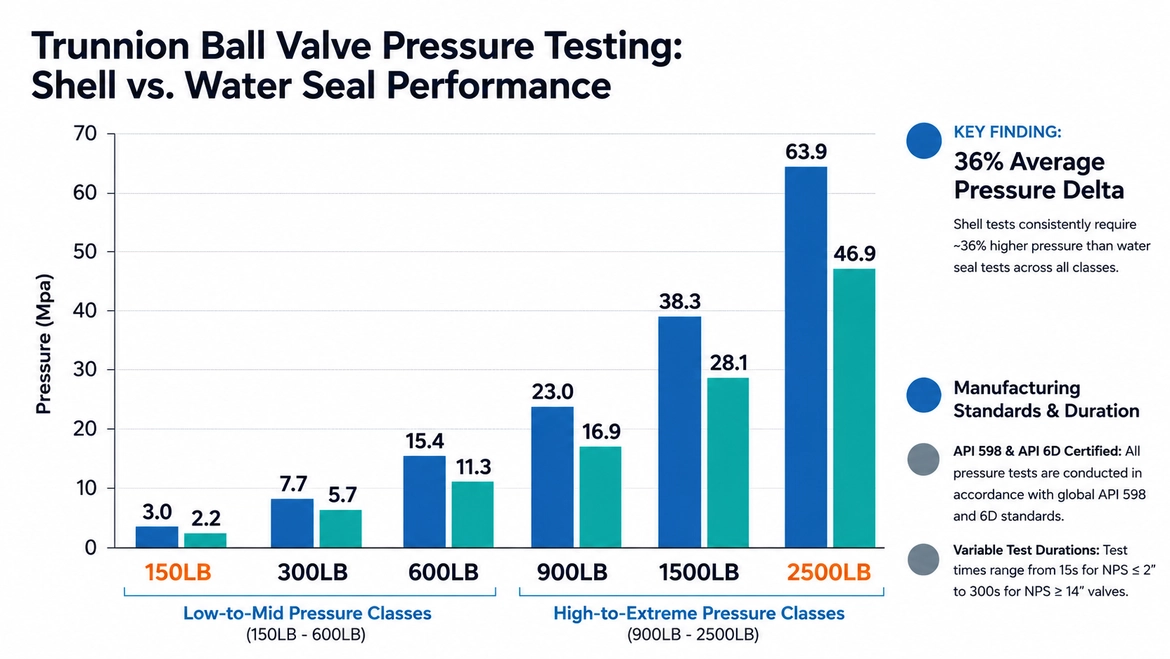
Typical Test Pressures for ASME Pressure Classes
| Nominal Pressure | Shell test (Mpa) | Water seal test (Mpa) | Air seal test (Mpa) |
|---|---|---|---|
| 150LB | 3.0 | 2.2 | 0.6 |
| 300LB | 7.7 | 5.7 | 0.6 |
| 600LB | 15.4 | 11.3 | 0.6 |
| 900LB | 23.0 | 16.9 | 0.6 |
| 1500LB | 38.3 | 28.1 | 0.6 |
| 2500LB | 63.9 | 46.9 | 0.6 |
Maintenance Considerations
Every pipeline ball valve should be periodically inspected for stem seal integrity, actuator performance, and seat leakage to ensure reliable isolation throughout its service life. The most frequent troubleshooting issue we see is seat erosion caused by construction debris left in the line during the commissioning phase. For units equipped with sealant injection fittings, emergency sealant can be injected into the seat area to temporarily reduce leakage until permanent repairs are completed.
Selection Guide for Pipeline Projects
Contractors should prioritize manufacturers that provide full material traceability, documented API 6D testing records, and sufficient production capacity to support large EPC pipeline projects. Our 18,000㎡ plant produces over 1 million units annually using 150 CNC lathes and 13 six-axis robots to ensure dimensional accuracy. Always verify that the pipeline shutoff valve carries an API 607 fire-safe certification to ensure it maintains shutoff capability during a thermal event.
Conclusion
The long-term performance of Indonesia’s gas grid rests on the reliability of every trunnion ball valve installed in its remote stations. By prioritizing API 6D compliance and robust material selection, operators can ensure high workflow efficiency and safety for decades. Trusting in the 38 years of manufacturing expertise at ONERO allows engineers to approach commissioning with the confidence that their flow control systems are built to withstand the rigors of the field.
FAQ
What defines a piggable ball valve for midstream use?
A piggable valve features a full bore design where the internal diameter matches the pipe, allowing maintenance “pigs” to pass through for cleaning and inspection without obstruction.
How do you troubleshoot seat leakage in a gas pipeline valve?
Technicians should check the cavity bleed port; if gas continues to escape, the seats are likely damaged, and for a pipeline isolation valve with proper fittings, emergency sealant can be injected to temporarily restore a seal.


