

A top entry ball valve is widely used in Indonesian LNG projects because it allows complete in-line maintenance without removing the valve from the pipeline. However, this does not mean every LNG application requires a top-entry design. Its use is most critical in high-pressure, high-downtime-cost, or difficult-access sections of the system.
For LNG facilities in remote regions such as East Kalimantan and West Papua, this design becomes particularly valuable in buried, insulated, or offshore-connected pipelines where valve removal would require major shutdown and excavation work.
Through the top bonnet, technicians can inspect or replace seats, seals, and ball assemblies without cutting pipework, disconnecting flanges, or removing the valve body. For LNG facilities in remote regions such as East Kalimantan and West Papua, this reduces maintenance time, lowers costs, and minimizes production downtime.
In LNG service, where reliability and continuous operation are critical, in-situ maintenance provides a significant advantage. Maintenance crews can perform inspections and repairs while the valve remains installed because only the top bonnet is removed during service, while the valve body stays welded to the pipeline. This eliminates the need for pipe cutting, flange separation, and realignment work, which are typically required in side-entry designs.
As a result, turnaround time is significantly reduced, and major pipeline intervention such as hot work, crane lifting, and post-weld testing can be avoided.
Indonesia’s Growing LNG Infrastructure
Indonesia is rapidly expanding its liquefaction and regasification capacity to meet both domestic energy demands and global export commitments. As an LNG pipeline valve, the top-entry design offers substantial maintenance advantages in remote facilities where valve removal requires extensive manpower and equipment. These coastal projects face harsh environments where salt-laden air and high humidity accelerate external corrosion, making the compact, one-piece body design vital for reducing external leak paths—specifically by eliminating mid-body bolted joints.
Valve Requirements in LNG Facilities
LNG facilities require hardware that can withstand the extreme “cold chain” of production, which often involves handling media at temperatures as low as -162°C. While various standards apply, compliance with API 6D is commonly specified for LNG pipeline isolation valves to ensure they meet rigorous design, manufacturing, and testing protocols. These systems must handle not only extreme cold but also high pressures, requiring materials that maintain their ductility and sealing integrity through thousands of thermal cycles.
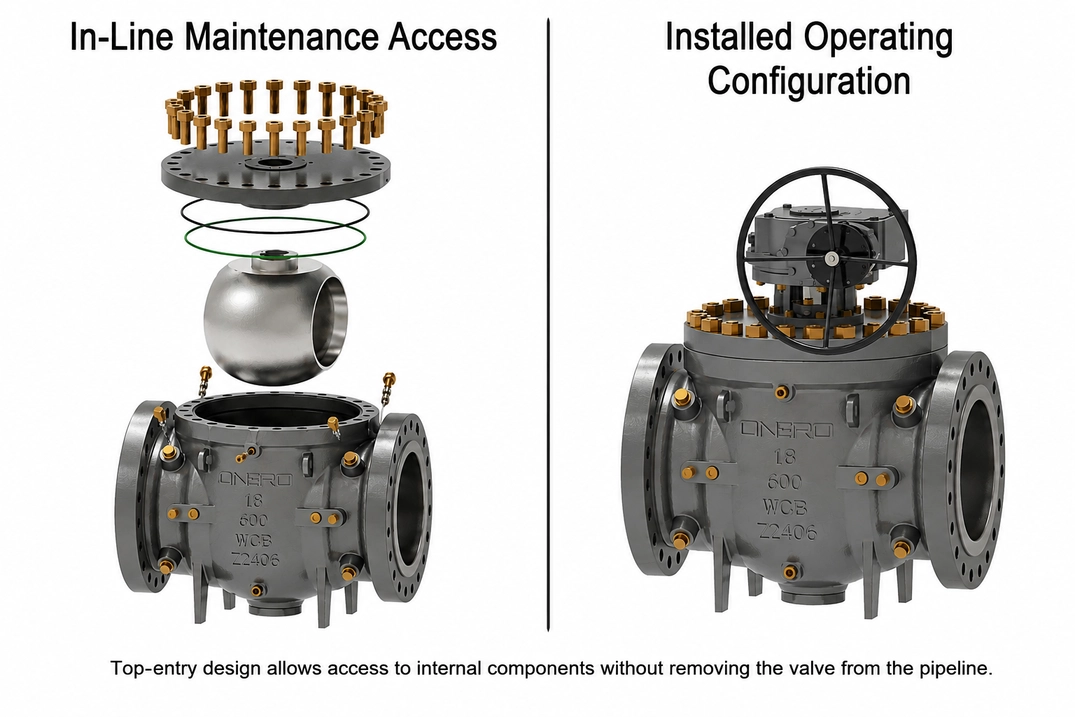
Engineers prefer the top-entry configuration because it solves the “buried valve” or “insulated valve” problem common in Indonesian regasification terminals. Unlike many side-entry valves that typically require removal from the pipeline to access internal components, the top-entry design features a removable cover (bonnet) secured with a bolted flange. This architecture allows technicians to inspect and replace critical internal parts without disturbing pipeline connections. The design also supports a more compact installation footprint while providing the durability required for continuous operation in isolated LNG terminals.
The Importance of In-Situ Maintenance
In-situ maintenance refers to the ability to repair a valve while the body remains welded to the infrastructure. By unbolting the top bonnet, technicians can perform a full inspection or replace worn seats while the pipeline connection stays intact. This is particularly vital for buried or heavily insulated pipelines where excavation or insulation removal is prohibitively expensive.

One hidden failure point many overlook is the buildup of line debris in the valve cavity; the top-entry design makes it significantly easier to flush and clean these areas during essential repairs.
Typical LNG Services
Within a modern LNG receiving terminal, valves are found in everything from unloading arms to regasification units. Each stage requires a different sealing strategy to manage volatile media, and the valve must provide bubble-tight shutoff for both liquid and gaseous service. Utilizing a cryogenic ball valve with an extended bonnet ensures the stem packing is kept away from the freezing media, preventing the valve from seizing or leaking due to extreme thermal contraction of non-metallic seals.
Top Entry Ball Valve vs Side Entry Ball Valve for LNG Projects
Choosing between these designs is often a matter of long-term operational efficiency versus initial acquisition cost. A top-entry trunnion ball valve utilizes fixed trunnion bearings at the top and bottom of the ball to absorb massive pipeline pressure loads. This design is superior for high-pressure service (ANSI Class 600–2500) because it prevents the ball from loading against the downstream seat, which reduces operating torque and significantly extends the service life of the internal seals.
| Feature | Side Entry Ball Valve | Top Entry Ball Valve |
|---|---|---|
| Pipeline Removal Required | Yes | No |
| In-Situ Maintenance | No | Yes |
| Access to Internal Components | Limited (Must remove) | Full Top Access |
| Best for Remote LNG Facilities | Moderate | Excellent |
| Maintenance Complexity | Higher (Rigging/Welding) | Lower (Mechanical) |
Material and Cryogenic Design Considerations
Material selection must comply with international standards to ensure the valve body can handle the specific chemical and thermal profile of the LNG flow. A high-quality low temperature ball valve typically utilizes ASTM A182 stainless steel, ASTM A351, or other cryogenic-grade materials qualified for LNG service. In our 38 years of research and development, we have found that precision-machined balls and spring-loaded seats are essential for maintaining contact across the full pressure range. It is also critical that the stem features an anti-blowout design as per API 6D requirements to prevent accidental ejection if the packing fails.
Selection Guide for EPC Contractors
Selection of a top entry ball valve for LNG EPC projects should follow a structured decision hierarchy rather than a simple checklist.
First, determine system criticality, distinguishing between main LNG trunk lines and auxiliary utility systems, as this defines whether in-situ maintenance capability is essential.
Second, evaluate maintenance strategy requirements, especially whether the system demands in-line servicing without pipeline shutdown.
Third, confirm bore configuration, where full-bore designs are required for pigging and inspection pipelines.
Fourth, select appropriate seat and body materials based on cryogenic performance requirements and media conditions.
Finally, verify certification and testing compliance, including API 6D, cryogenic testing, and project-specific approval standards.
A reliable API 6D ball valve should be backed by rigorous hardness, dimensional, cryogenic, and hydrostatic testing to support long-term operation in critical energy infrastructure.

Top-entry, corrosion-resistant design. Easymaintenance. 1/2″-48″ size, 2500LB.
View ProductConclusion
The strategic value of a top-entry ball valve for Indonesian LNG projects lies in its ability to maximize facility uptime while minimizing the risks of pipeline intervention. Shifting from total valve removal to in-situ maintenance directly improves the bottom line and ensures the long-term safety of the energy infrastructure. By choosing a manufacturer with 38 years of experience like ONERO, contractors can be confident in receiving high-performance valves engineered for field survival. For projects requiring API 6D compliance, cryogenic performance, and simplified maintenance access, ONERO provides engineered top entry ball valve solutions designed for demanding LNG applications.
FAQ
What is a top entry ball valve used for?
It is commonly used in LNG terminals, transmission pipelines, and other critical facilities where maintenance access is required without removing the valve body from the pipeline.
What is the process for in-situ maintenance?
The line is safely isolated and depressurized before the top bonnet is removed. Internal components such as the ball, seats, and stem can then be inspected or replaced without cutting the pipeline or removing the valve body.


